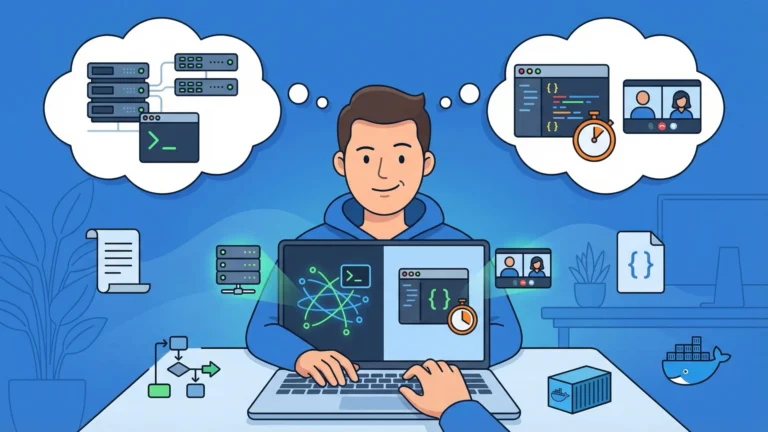


You’ve spent years keeping servers alive, automating deployments, and debugging production outages at 2 AM. Then you apply for a senior role, and the recruiter says four words that make your stomach drop: “There’s a coding round.” Not a quiz about inodes or systemd units. An actual coding assessment on a platform you’ve never used, with a timer counting down and someone watching you type.
Here’s the thing nobody tells you: the modern coding interview for sysadmins isn’t the same beast software engineers face. You won’t be reversing linked lists or implementing binary search trees. But you will need to write structured, testable code under pressure—and your years of operational experience are a bigger advantage than you think.
The Interview Has Changed (And It’s Actually in Your Favor)
The old sysadmin interview was trivia night. “What’s an inode?” “Explain the boot process.” “What port does SSH use?” You either knew the answer or you didn’t. Those days are fading.
Today’s sysadmin and DevOps interviews increasingly use live coding platforms that simulate real work environments. Instead of whiteboard puzzles, you get a terminal, a file system, and a problem that looks suspiciously like something you’d actually encounter on a Tuesday afternoon. Parse this log file. Fix this broken deployment. Write a script to call this API and clean up stale resources.
Key Insight: The shift toward practical, “work-sample” style assessments means your daily work IS your interview prep. The challenge is translating what you do instinctively into clean, presentable code under observation.
That shift happened because hiring managers realized something: a candidate who can reverse a linked list in Python but can’t troubleshoot a failed cron job isn’t useful in operations. The industry wants proof you can automate, debug, and build tooling—not that you memorized an algorithms textbook.
Know Your Platform: Where the Interview Happens
Before you worry about algorithms, get comfortable with the tools. Modern coding interviews happen on platforms designed to simulate real development environments, and fumbling with the interface wastes precious minutes.
| Platform | Standout Feature | Why It Matters for You |
|---|---|---|
| CoderPad | Multi-file projects with drag-and-drop file upload | You can organize scripts, configs, and test files like a real project |
| CodeSignal | Filesystem simulation with integrated unit testing | Tests live alongside your code—write automation the way you’d write IaC |
| HackerRank | In-browser Linux VM with root access | Full terminal, Docker, package management—your actual working environment |
Each platform has quirks. CoderPad gives you an interactive shell alongside the code editor, so you can run grep, awk, and curl while writing your solution. CodeSignal stores test files as actual files in a project tree (like tests/test_script.py), reinforcing the Infrastructure as Code pattern of testing your automation. HackerRank goes furthest—their DevOps assessments provision a full Linux VM with pre-installed tooling, and some roles even get a temporary AWS sandbox for hands-on cloud tasks.
Pro Tip: Spend 30 minutes in each platform’s free sandbox before your interview. Getting used to browser-based editors, the slight input lag, and the lack of your beloved keybindings will save you real panic on interview day.
Pick Your Language (But You Probably Already Know the Answer)
You’ve been writing Bash for years. It’s fast, it’s powerful, and you can chain together grep | awk | sort | uniq -c | sort -rn in your sleep. So why does every job listing say “Python required”?
Because Bash breaks down the moment you need real data structures, error handling, or cross-platform portability. That one-liner you wrote to parse Apache logs? It works great until someone asks you to handle JSON output, retry failed API calls, or process 50GB of data without loading it all into memory.
Python fills exactly that gap. Its standard library gives you everything operations work demands—os and sys for system interaction, re for regex, json for parsing API responses, and collections.Counter for counting things in log files (which is basically half of what sysadmins do).
| Situation | Use Bash | Use Python |
|---|---|---|
| Quick text processing with pipes | Yes | Overkill |
| Parsing structured data (JSON, CSV) | Painful | Built-in |
| API calls with auth and pagination | Fragile | Robust |
| Complex logic with error handling | Nightmare | Straightforward |
| One-liner log analysis | Perfect | Verbose |
The Stack Overflow Developer Survey consistently ranks Python among the most widely used programming languages. For DevOps and Site Reliability Engineering (SRE) specifically, Python and Bash form the essential pair—Bash for quick glue code, Python for anything that needs to survive past your current shell session.
Reality Check: You don’t need to choose one language. The best answer in an interview is often “I’d use Bash for this part and Python for that part”—and then explain why. That kind of pragmatic judgment is exactly what hiring managers want from operations hires.
There’s a third option gaining ground: Go. Kubernetes, Docker, and Terraform are all written in Go, and senior SRE roles increasingly expect familiarity with it. You don’t need to master it for most sysadmin interviews, but knowing it exists and when you’d reach for it signals awareness of where infrastructure tooling is headed.
The Four Problem Types You’ll Face
Forget dynamic programming and graph traversal. Sysadmin coding interviews pull from a different playbook—one that should feel familiar.
Log Parsing and Analysis
This is the most common problem type. You’ll get a log file (sometimes uploaded directly into the platform) and a question like: “Find the top 10 IP addresses by request count” or “Calculate the error rate per minute for the last hour.”
The solution usually looks like this:
from collections import Counter

def top_ips(log_path, n=10):
    ip_counts = Counter()
    with open(log_path) as f:
        for line in f:
            ip = line.split()[0]
            ip_counts[ip] += 1
    return ip_counts.most_common(n)
Notice what’s happening here: you’re reading line by line (not loading the whole file into memory), extracting the relevant field, and counting occurrences. That’s it. No fancy algorithms. But the interviewer is watching for whether you handle the file efficiently, whether you consider edge cases (empty file? malformed lines?), and whether you can explain your choices.
API Interaction and Automation
“Write a script that queries the GitHub API and lists your assigned open issues in an organization that are older than 30 days.” You’ll need to handle HTTP requests, JSON parsing, authentication headers, and pagination. The requests library is usually available, but know how to use urllib from the standard library as a backup.
Here’s what the basic structure looks like:
import os
import requests
from datetime import datetime, timedelta

def old_open_issues(org, days=30):
    url = f"https://api.github.com/orgs/{org}/issues"
    headers = {"Authorization": f"token {os.environ.get('GITHUB_TOKEN')}"}
    params = {"state": "open", "per_page": 100}

    cutoff = datetime.now() - timedelta(days=days)
    old_issues = []

    response = requests.get(url, headers=headers, params=params)
    for issue in response.json():
        created = datetime.strptime(issue['created_at'], "%Y-%m-%dT%H:%M:%SZ")
        if created < cutoff:
            old_issues.append(issue['html_url'])

    return old_issues
This demonstrates environment variable handling for credentials, pagination awareness (you’d add a loop for next links in production), and date parsing. The interviewer wants to see that you think about authentication, rate limiting, and error handling—not just whether you can call an API endpoint.
Infrastructure Validation
“Here’s a Terraform file. Find the security vulnerability.” Or: “Write a script that checks whether all S3 buckets in this account have encryption enabled.” These questions test your understanding of cloud security patterns and your ability to write policy-as-code checks.
A typical validation script might look like this:
import boto3
from botocore.exceptions import ClientError

def check_bucket_encryption():
    s3 = boto3.client('s3')
    buckets = s3.list_buckets()['Buckets']

    unencrypted = []
    for bucket in buckets:
        name = bucket['Name']
        try:
            s3.get_bucket_encryption(Bucket=name)
        except ClientError as e:
            if e.response['Error']['Code'] == 'ServerSideEncryptionConfigurationNotFoundError':
                unencrypted.append(name)

    return unencrypted
Warning: Since January 2023, AWS applies default SSE-S3 encryption to all S3 buckets, so get_bucket_encryption now returns a configuration instead of throwing that exception—you won’t find truly “unencrypted” buckets anymore. The pattern still works for demonstrating boto3 exception handling and compliance validation in an interview, but if you want to really impress, adapt it to check for specific encryption types like SSE-KMS.
This shows you understand AWS SDK patterns, exception handling for missing configurations, and how to structure a compliance check. You’re not just checking state—you’re demonstrating security awareness and the operational mindset of “validate everything.”
Live Debugging
The most sysadmin-specific format: you get a terminal connected to a broken environment. The web server returns 500 errors. Fix it. This is where your daily work translates directly—check processes with ps aux, examine logs with journalctl or tail -f, test connectivity with curl and dig, verify permissions with ls -la. The coding part is minimal; the systems thinking is everything.
A typical debugging sequence might look like this:
# Check if the service is running
systemctl status nginx

# Check recent logs for errors
journalctl -u nginx --since "5 min ago" | grep -i error

# Test connectivity
curl -v http://localhost:80

# Check configuration syntax
nginx -t

# Check file permissions
ls -la /var/www/html/

# Check listening ports
netstat -tlnp | grep :80
The interviewer isn’t timing how fast you type commands—they’re watching your diagnostic methodology. Do you start broad and narrow down? Do you check logs before restarting services? Do you verify your hypothesis before applying a fix? That systematic approach is what separates experienced operators from people who got lucky on LeetCode.
Preparation That Works
The worst thing you can do is grind LeetCode medium problems for three weeks. That’s preparation for a different interview. Here’s what to focus on instead.
Practice in the browser. Your local VS Code setup with custom themes, extensions, and 47 keyboard shortcuts? You won’t have any of it. Spend time writing code in CoderPad’s sandbox or HackerRank’s practice environment. Get comfortable with the friction.
Master Python’s standard library for operations. You won’t always have pip install available. Get fluent with these modules:
-
re— regex for log parsing and text extraction -
json— parsing API responses and config files -
osandpathlib— file system operations -
subprocess— running system commands from Python -
collections—Counter,defaultdict, anddequefor data processing -
argparse— building CLI tools with proper argument handling
Build a muscle memory for Bash one-liners. Interviewers love watching you solve a quick problem with a pipeline. Have these patterns ready:
# Top 10 IPs from an access log
awk '{print $1}' access.log | sort | uniq -c | sort -rn | head -10

# Error rate from syslog
grep -c "ERROR" /var/log/syslog

# Find files modified in the last 24 hours
find /var/log -mtime -1 -type f
Think out loud about production concerns. This is your unfair advantage. When you write a script in an interview, narrate the operational thinking:
-
“I’m reading line by line instead of
readlines()because this log file could be huge in production.” -
“I’m using environment variables for this API key instead of hardcoding it.”
-
“I’d add retry logic here because network calls to external APIs can flake.”
-
“I’m including logging so if this runs as a cron job and fails, we’ll know why.”
That commentary separates you from a software engineer who can code but has never thought about what happens when code runs at scale, in production, at 3 AM.
How Your Operations Experience Gives You an Edge
You have knowledge that pure coders don’t. Use it deliberately.
| What You Know | How to Show It |
|---|---|
| Memory constraints matter | “I’m using a generator instead of a list—log files get massive.” |
| Networks are unreliable | “I’ll add a retry with exponential backoff for this API call.” |
| Observability is critical | “This script logs every action so the next person can debug it.” |
| Security is non-negotiable | “Credentials come from env vars, never hardcoded.” |
| Things fail | “What happens if this file doesn’t exist? Let me handle that.” |
When you frame your coding through the lens of reliability, security, and operational awareness, you demonstrate value that a software engineer prepping LeetCode problems all week simply can’t match. You’re not just writing code that works—you’re writing code that survives production.
The Day-Of Checklist
Your interview is tomorrow. Here’s what to have ready.
-
Environment tested. You’ve used the specific platform (CoderPad, HackerRank, CodeSignal) at least once. Your browser works, your webcam works, your internet is stable.
-
Language warmed up. You’ve written at least one Python script that reads a file, processes data, and outputs results. You’ve run a few Bash one-liners.
-
Standard library cheat sheet. Not to cheat—most interviews allow documentation lookups. But having a quick reference for
collections.Counter,re.findall, andjson.loadssaves you from blanking under pressure. -
Narration practiced. You’ve talked through a problem out loud at least once. It feels awkward the first time. Do it anyway.
-
Operational examples queued. You have two or three real scenarios from your work where you automated something, debugged a production issue, or built a tool. Be ready to reference them when explaining your approach.
What the Interviewer Actually Wants
Here’s the part most prep guides skip. The person on the other side of that screen isn’t looking for perfect code. They’re looking for three things:
Can you solve real problems? Not abstract puzzles—actual operational problems. Log parsing, API automation, system debugging. The kind of problems that land in your ticketing queue every week.
Can you write code that others can maintain? Clean variable names, functions with clear purposes, comments where the logic isn’t obvious. Your one-liner Bash wizardry is impressive, but if nobody else can read it, it’s a liability in a team environment.
Do you think about what happens next? What if the file is empty? What if the API rate-limits you? What if this script needs to run on a server with 512MB of RAM? That production-first mindset is your differentiator. Lean into it.
You’ve been solving problems in production your entire career. The coding interview is just that, but with someone watching. Show them how you think, not just what you type.