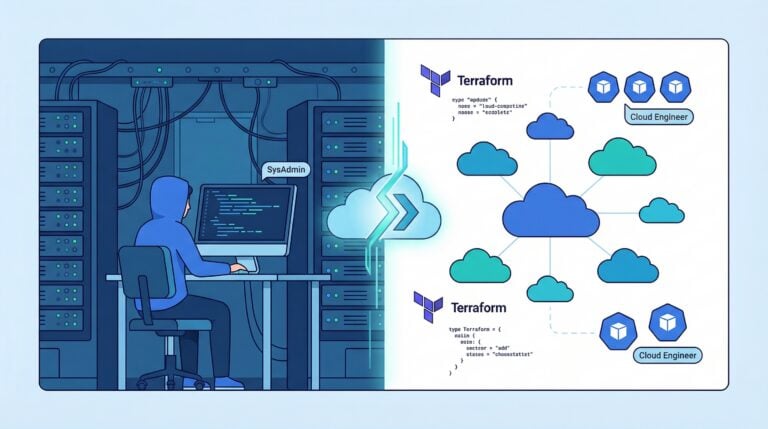


Every few years, IT infrastructure shifts far enough that entire job categories either evolve or evaporate. The last decade’s cloud migration wasn’t just a platform change—it quietly redrew the boundary between “keeping systems running” and “designing systems that run themselves.” If you’ve spent years as a system administrator, you’re standing at that boundary right now.
The market numbers make the opportunity undeniable. Global cloud spending is projected to reach approximately $723 billion in 2025, growing over 21% year-over-year. Cloud engineering roles are being created faster than they can be filled. And former SysAdmins—people who already understand networking, operating systems, and the operational reality of production environments—are precisely the candidates cloud teams want. The gap is in tooling and philosophy, not foundational knowledge.
The Operational Shift You Need to Internalize First
Before any tooling conversation, there’s a philosophical reorientation that determines whether the transition sticks or whether you keep reverting to old habits under pressure.
Traditional system administration is fundamentally reactive and imperative. You receive a ticket, you SSH into a box, you make a change, you close the ticket. The infrastructure reflects every decision made by every administrator who touched it over years. That accumulation is called configuration drift, and managing it is essentially the whole job.
Cloud engineering is declarative and proactive. You don’t describe what to do—you describe what should exist. The tooling reconciles the current state against the desired state and makes it so. Drift is detected automatically. Manual interventions become anti-patterns.
This maps onto a well-known distinction in the industry: “pets vs. cattle.” SysAdmins treat servers like pets—named, individually maintained, nursed back to health when ill. Cloud engineers treat infrastructure like cattle—interchangeable, disposable, replaced rather than repaired. That’s not callousness; it’s the architecture of systems that self-heal at 3 AM without waking you up.
The salary premium for internalizing this shift runs 20-40% above traditional SysAdmin compensation. Entry-level cloud engineering roles start between $90,000 and $115,000—a jump that, for many SysAdmins in the $70,000-$90,000 range, represents the single largest salary increase of their career. Mid-level positions range from $125,000 to $150,000, and senior specialists in areas like security and AI infrastructure reach $160,000 to $200,000 and above. The market is pricing the philosophy, not just the tool knowledge.
What Your SysAdmin Background Already Gives You
The transition path looks steeper than it is because most discussions focus on what you need to learn and skip what you already know. That framing is wrong.
Your networking background is directly applicable. Understanding CIDR blocks, subnetting, DNS resolution, and routing is mandatory for configuring Virtual Private Clouds. The concepts are identical; only the interface changes. Where you once configured a VLAN, you now define a VPC subnet in code. Where you managed firewall rules in a GUI, you define Security Groups or Network ACLs in a configuration file.
Your Linux proficiency transfers completely. Cloud servers—AWS EC2 instances, Google Compute Engine VMs, Azure virtual machines—are predominantly Linux. Bash scripting, filesystem hierarchy, process management, log analysis: all of it moves with you. The environment looks familiar. Only the provisioning method changes.
Your operational instincts are an advantage that cloud-native engineers often lack. You know what happens when a database runs out of disk space at 2 AM. You’ve seen what bad certificate management costs. You understand why change management exists. Former SysAdmins who make the transition often have an operational edge over engineers who learned cloud in academic or greenfield environments precisely because they’ve operated systems under real conditions.
The Technical Domains to Build
With the transferable foundation established, three technical domains represent the actual learning surface of the transition.
Infrastructure as Code is the most significant shift. Terraform is the industry standard for defining cloud resources in code. The core concept is the state file—a mapping between your configuration code and the real-world resources it represents. If a resource exists in your cloud account but not in the state file, Terraform doesn’t manage it. If someone makes a manual change through the AWS Console, terraform plan will detect the drift and report exactly what changed. terraform apply will revert it.
This is a fundamental departure from SysAdmin work. The correct response to a configuration problem is to update the code and re-apply, not to SSH in and fix it. Manual changes bypass the audit trail, break the state file, and reintroduce the drift problem you’re specifically trying to solve.
The declarative model also solves the idempotency problem that plagues imperative scripting. A Bash script that creates a directory fails if the directory already exists. A Terraform configuration that declares a resource creates it if absent, leaves it alone if present, and updates it if the spec changed. Running it ten times produces exactly one resource, correctly configured. This property—idempotency—is foundational to reliable automation.
Container orchestration represents the second major domain. The shift from virtual machines to containers is architectural. VMs run a full guest operating system on top of a hypervisor—CPU and RAM overhead is significant. Containers share the host OS kernel. They’re isolated processes using Linux namespaces and cgroups, not separate operating systems. This allows substantially more workloads per host.
Kubernetes manages containers at scale through a continuous reconciliation loop. You define desired state—”I want three replicas of this application”—and the controller watches the cluster, comparing current state to desired state, and takes corrective action when they diverge. A pod crashes: Kubernetes detects the discrepancy, terminates the failed pod, and schedules a replacement. No PagerDuty alert. No manual intervention. The system heals itself.
CI/CD pipelines complete the technical picture. Continuous Integration and Continuous Deployment automate the path from code commit to running infrastructure. You’ll interact with systems like GitHub Actions, GitLab CI, or Azure DevOps Pipelines to build, test, and deploy changes automatically. The operational instinct that makes SysAdmins valuable here is understanding what can go wrong in deployment—that knowledge directly informs how to build pipelines that catch failures before they reach production.
The Certification Path
Certifications serve two functions in this transition: they structure the learning path and they signal competency to hiring managers who can’t evaluate cloud skills through a resume alone.
The practical sequence starts with picking one provider. Depth on one platform is worth more than surface coverage of three. Azure is the natural fit if you’re coming from a Windows Server environment. AWS is the market-share leader. Either is a solid foundation.
For AWS-focused paths, the AWS Certified Solutions Architect – Associate (SAA-C03) establishes how cloud components fit together architecturally. It’s not an operations exam—it tests whether you can design systems, not just configure them.
For Azure-focused paths, the Microsoft Certified: Azure Administrator Associate (AZ-104) maps most directly to SysAdmin background and Windows Server experience.
After the cloud provider certification, the HashiCorp Certified: Terraform Associate formalizes IaC competency. The Certified Kubernetes Administrator (CKA) is a hands-on practical exam that carries significant weight in job postings for container platform roles.
Where You Have a Structural Advantage
You’re not entering cloud as a blank slate—and the market knows it. The skills shortage is real, but it isn’t uniform. The specific gap that former SysAdmins fill is in hybrid and multi-cloud environments, exactly the territory where on-premises experience becomes an asset rather than a liability.
When you’re running workloads across Azure and AWS, or bridging cloud and on-premises data centers, you need engineers who understand both sides. Cloud-native engineers who learned their craft in greenfield environments often have limited exposure to physical infrastructure and legacy integration patterns. You have that exposure already.
The practical starting point is finding a project in your current role that benefits from cloud tooling—automating scheduled tasks, standing up a small test environment in AWS or Azure, implementing a basic Terraform workflow for something low-stakes. Hands-on experience connected to work you already understand builds muscle memory faster than isolated lab exercises.
Key Insight: Pick one cloud provider to start. Depth on one platform is worth more than surface coverage of three. Azure is the natural fit if you’re coming from a Windows Server environment. AWS is the market-share leader. Either is a solid foundation.
Translating Your Tool Vocabulary
One cognitive shift that accelerates the transition is mapping familiar tools to their cloud equivalents—you’ll recognize the purpose immediately, even if the implementation looks different.
| What You Know | Cloud Equivalent |
|---|---|
| VMware ESXi / Hyper-V | AWS EC2, Azure VMs, Kubernetes Pods |
| Bash / PowerShell scripts | Terraform, Ansible |
| Nagios / SolarWinds / PRTG | Prometheus, Datadog, AWS CloudWatch |
| Manual firewall rules | AWS Security Groups / NACLs, Azure NSGs |
| Shared folder on a server | S3 / Azure Blob Storage |
| On-prem load balancer | AWS ALB / Azure Application Gateway |
The concepts are the same. The implementation is code. If you want to map your existing monitoring vocabulary to its cloud equivalent, Prometheus is worth understanding early—it’s the de facto standard for cloud-native metrics collection.
Reality Check: The “ClickOps” habit—making changes through the cloud console’s GUI instead of code—is the single most common failure mode for former SysAdmins learning cloud. It feels productive. It produces drift. Commit to the code-first workflow from day one, even when it’s slower initially.
Building the Portfolio That Gets You Hired
Certifications open doors. A GitHub repository with working Terraform code keeps them open.
Cloud hiring managers evaluate candidates differently than traditional IT hiring. A portfolio of Terraform modules that provision real infrastructure—a three-tier web application, a scheduled shutdown automation for dev environments, a Kubernetes cluster with a deployed application—demonstrates operational competency more directly than certifications alone.
The three-tier application is the canonical demonstration project. A VPC with public and private subnets, an auto-scaling group for the web tier, an RDS instance for the database tier, security groups properly scoped to each layer. Provisioned entirely through Terraform. If you can build that, describe the decisions you made, and explain what happens when terraform plan detects drift—you can have that conversation in any cloud engineering interview.
Pro Tip: Document your learning publicly. A blog post explaining how you converted a manual deployment process to Terraform, or how you configured Kubernetes self-healing for a test application, signals the engineering mindset that distinguishes candidates. You’re demonstrating you understand not just what the tools do, but why they exist.
The Timeline
The transition from SysAdmin to cloud engineer is realistic in six to twelve months with deliberate effort. The first two months cover the cloud provider fundamentals and certification. Months three and four add Terraform and IaC practice. Months five and six introduce containers and Kubernetes. The remaining time builds the portfolio and targets roles. If you want a structured learning framework, the AWS Skill Builder and Microsoft Learn platforms offer free paths organized exactly by this progression.
The SysAdmin background compresses this timeline compared to career changers starting from zero. You’re not learning operations from scratch—you’re learning a new execution model for operations you already understand.
Cloud engineering is where the infrastructure career path leads right now. The tools are different. The philosophy takes adjustment. The foundational knowledge you’ve built is not a liability to overcome—it’s the starting point that gets you there faster.