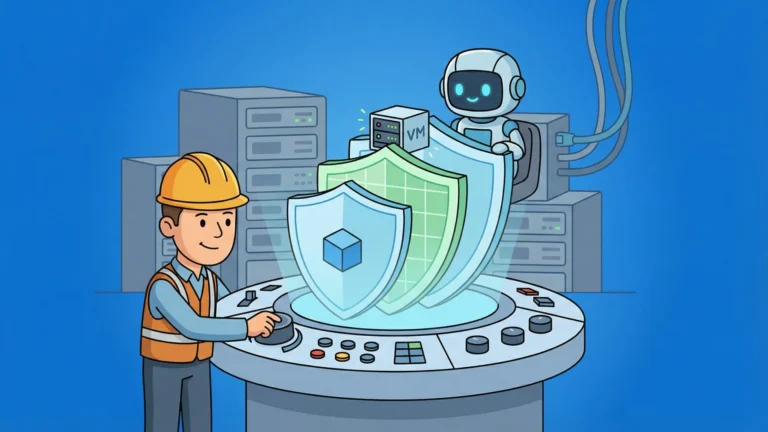


One compromised AI agent doesn’t just crash your app. It gives attackers kernel-level access to your entire Kubernetes node, every pod running on it, and potentially the cluster control plane. That’s the security boundary you’re working with when you run AI agents in standard containers. The question isn’t whether to add isolation—it’s which technology provides the right balance of security, performance, and Azure integration.
You have three options: keep using standard containers with namespace isolation (the default Linux process boundary), add gVisor’s syscall filtering layer (intercepting the system calls your container makes to the host kernel), or deploy hardware-backed microVMs. Each creates a different security boundary, each carries performance tradeoffs, and each integrates with Azure differently. Here’s how to choose.
The Security Boundaries Explained
| Technology | Isolation Type | Attack Surface | Azure Implementation |
|---|---|---|---|
| Standard Containers | Namespace/cgroup (process-level boundaries) | Host kernel (shared) | Default AKS runtime |
| gVisor | Syscall interception | User-space kernel proxy | Manual installation only |
| Kata Containers | Hardware virtualization | Guest VM kernel | AKS Pod Sandboxing |
| Hyper-V Isolation | Hardware virtualization | Guest VM kernel | Azure Container Apps Dynamic Sessions |
Standard containers share the host kernel. If your AI agent executes malicious code that exploits a kernel vulnerability, the attacker escapes the container. That’s not theoretical—14% of third-party breaches in 2024 involved file transfer platforms, and AI agents processing untrusted input face similar risks.
gVisor interposes a user-space kernel between your container and the host. System calls hit gVisor’s Sentry component instead of the host kernel, reducing the attack surface. But it’s not perfect—nvproxy, gVisor’s GPU passthrough mechanism, still exposes some kernel paths, and gVisor only supports selected NVIDIA driver versions and CUDA commands.
MicroVMs run each container in its own lightweight virtual machine. Kata Containers on AKS and Hyper-V isolation in Container Apps both use this approach. An attacker who compromises the container must first escape the VM, then breach the hypervisor—a significantly harder exploit chain than breaking out of namespace isolation.
Key Insight: The security boundary you choose determines whether a compromised agent is a container restart or a security incident.
When Standard Containers Are Enough
You don’t need hardware isolation if your agents only execute code you control. Internal automation agents that run pre-validated scripts, agents that query APIs without executing returned code, or agents that process data without calling eval() work fine in standard containers.
The performance advantage matters here. Standard containers start in roughly 50 milliseconds with zero runtime overhead. Your agents access GPUs directly through the NVIDIA Container Toolkit, and you avoid the complexity of managing alternate runtimes.
But the moment your agent executes LLM-generated code—Python for data analysis, shell commands for system operations, or code returned from external APIs—standard containers become inadequate. One successful exploit and you’re explaining to your security team why an AI chatbot has root access to your production Kubernetes nodes.
The gVisor Middle Ground
gVisor sits between standard containers and full virtualization. It intercepts system calls in user space, preventing direct kernel access. For CPU-intensive workloads like LLM inference that don’t hit the kernel frequently, gVisor performs close to native speed.
The overhead appears in I/O operations. File system writes, network calls, and disk operations can show 20–50% performance degradation because every syscall must pass through gVisor’s Sentry proxy. If your agent writes large log files, processes streaming data, or handles high-throughput API calls, that overhead accumulates.
GPU support through nvproxy works for some workloads but not others. gVisor currently only supports CUDA-related commands, which means PyTorch and TensorFlow inference generally work, but video encoding, transcoding, or other non-CUDA GPU workloads fail. The supported driver versions align with Google Kubernetes Engine‘s driver support, which may not match your Azure environment.
More importantly, gVisor isn’t a first-class citizen on Azure. Microsoft doesn’t provide managed gVisor support on AKS. You can install it manually, but you own the operational burden—updates, compatibility testing, and troubleshooting. When Azure updates the Kubernetes version or changes the node image, you verify gVisor still works.
Choose gVisor if: You’re already running it elsewhere, you have ops capacity to maintain it, and your workload is CPU-bound with minimal I/O.
Skip gVisor if: You need turnkey Azure integration, your workload requires heavy I/O, or you’re using non-CUDA GPU operations.
Kata Containers for GPU-Backed Isolation
AKS Pod Sandboxing implements Kata Containers using Azure Linux as the host OS. Each pod runs in its own lightweight VM with its own kernel, creating a hardware boundary between your agent and the host.
This matters most when you need GPU access with strong isolation. Unlike gVisor’s nvproxy, Kata supports full GPU passthrough—one GPU per pod. You can run untrusted inference models uploaded by users, or host multi-tenant AI workloads where each tenant’s agent runs on dedicated hardware.
Startup latency runs 200–300 milliseconds, roughly 4-6x slower than standard containers. For conversational agents where users expect sub-second response times, that boot delay becomes noticeable. Runtime performance after startup approaches native speed thanks to virtualization extensions.
The operational complexity increases. You need a dedicated node pool running Azure Linux, you deploy pods with runtimeClassName: kata-vm-isolation, and you accept that some Azure features aren’t supported—Microsoft Defender for Containers doesn’t assess Kata pods, and host-network access doesn’t work.
For regulated workloads requiring memory-level protection, Azure offers confidential computing options that use AMD SEV-SNP memory encryption (hardware-level isolation that encrypts VM memory so even the hypervisor can’t read it). Confidential VM node pools on AKS protect your agent’s data from the Azure hypervisor itself. If you’re processing healthcare data, financial records, or other regulated information, confidential computing provides the strongest available isolation boundary.
Choose Kata Containers if: You need GPU access for inference, you’re running untrusted models, or you need confidential computing guarantees.
Skip Kata Containers if: Your agents don’t need GPUs, startup latency matters more than isolation, or you can’t accept the operational overhead.
Reality Check: Kata’s 200ms startup delay disappears into network latency for most AI workflows. The real cost is operational complexity, not performance.
Hyper-V Isolation for Code Execution
Azure Container Apps Dynamic Sessions abstracts Hyper-V isolation specifically for ephemeral code execution. This is purpose-built for the “code interpreter” pattern—an agent generates Python or JavaScript, executes it in a sandbox, and returns the result.
Dynamic Sessions solves the microVM cold start problem by maintaining a warm pool of unallocated Hyper-V sandboxes. When your agent requests a session, it gets assigned an existing sandbox in under 100 milliseconds at the 90th percentile. After execution, the session is destroyed or returned to the pool.
The integration with AI frameworks makes this the fastest path to production. LangChain, Semantic Kernel, and LlamaIndex all provide native tools that abstract the session management API. You add a code interpreter capability to your agent with a few lines of code.
The tradeoff is limited customization. Dynamic Sessions run Python and JavaScript environments. You can install packages at runtime, but you can’t customize the base image, you can’t mount persistent storage, and you don’t get GPU access. This isn’t an inference platform—it’s a secure execution environment for generated code.
Multi-tenancy is built in. Each session gets its own isolated sandbox. User A’s code never sees User B’s session, and sessions can’t access each other even if they’re running simultaneously on the same host. For SaaS AI applications where you need per-user isolation without managing infrastructure, this is the obvious choice.
Choose Dynamic Sessions if: Your agents generate and execute code, you need instant scaling, or you want framework integration without managing VMs.
Skip Dynamic Sessions if: You need custom environments, persistent storage, or GPU access.
The Performance Reality
Benchmarking isolation technologies reveals predictable patterns. Standard containers win on raw speed. gVisor penalizes I/O. MicroVMs add boot latency but run at near-native speeds.
For LLM inference specifically, the isolation overhead often matters less than model size and GPU memory bandwidth. A GPT-4-level model running on an A100 GPU spends most of its time in matrix multiplication, not syscalls. Whether that runs in a standard container or a Kata VM, the GPU does the same work at the same speed.
The startup latency matters more for conversational agents. Users notice delays above 500ms. Standard containers meet that budget easily. Dynamic Sessions usually meet it via warm pooling. Kata Containers might exceed it on cold starts.
Network-intensive agents show different patterns. If your agent makes hundreds of API calls per request—querying vector databases, calling external services, fetching data from storage—gVisor’s syscall overhead accumulates. MicroVMs with paravirtualized I/O (direct hardware access through the hypervisor, bypassing emulation) perform better.
Implementation Decision Matrix
| Scenario | Recommended Technology | Why |
|---|---|---|
| Trusted internal agents | Standard containers | No isolation overhead needed |
| CPU-bound inference, no GPU | gVisor | Good security/performance balance for non-Azure-native workloads |
| GPU inference, untrusted models | Kata Containers on AKS | Only option with GPU passthrough + hardware isolation |
| Code interpreter agents | Dynamic Sessions | Purpose-built for the use case, lowest operational burden |
| Regulated data processing | Confidential VMs on AKS (AMD SEV-SNP) | Memory encryption required for compliance |
| Multi-tenant SaaS agents | Dynamic Sessions or Kata | Depends on whether you need GPUs |
The right choice depends on your specific threat model. If you’re building an internal Slack bot that queries your documentation, standard containers work. If you’re building a SaaS product where users upload Python notebooks that your agent executes, Dynamic Sessions or Kata become mandatory.
What Azure Gets Right
Microsoft’s security investments cluster around two technologies: Kata for long-running, GPU-backed workloads, and Hyper-V for ephemeral code execution. They’re not positioning gVisor as a primary option, and the lack of first-party support tells you where they think the market is going.
Dynamic Sessions supports serverless GPUs and per-second billing, addressing what was previously a major limitation—you can run GPU-backed inference in a Hyper-V sandbox without managing infrastructure. That changes the decision matrix. If you need GPUs for short-lived tasks, Dynamic Sessions becomes viable where it previously wasn’t.
The warm pool architecture matters more than most teams realize. Cold-starting a VM takes time. Keeping a pool of pre-allocated sandboxes means users don’t wait for boot. The cost of that pool amortizes across all your agents. For a SaaS provider with thousands of concurrent sessions, the efficiency gain is substantial.
Pro Tip: If you’re prototyping, start with Dynamic Sessions. If it works for your use case, you avoid the operational complexity of managing Kata on AKS.
The Bottom Line
Standard containers don’t provide sufficient isolation for AI agents executing untrusted code. The shared kernel creates an escape path that’s been exploited repeatedly in production environments.
gVisor improves the security posture but carries I/O overhead and lacks Azure support. You’re on your own for updates and troubleshooting.
Kata Containers on AKS provide hardware isolation with GPU passthrough, making them the right choice for inference workloads that need strong security boundaries. The operational complexity is real, but manageable for teams already running Kubernetes at scale.
Dynamic Sessions abstract Hyper-V isolation into a serverless API, purpose-built for code execution. For agents that generate and run Python or JavaScript, this is the path of least resistance with enterprise-grade security.
Your decision depends on three factors: whether you need GPU access, whether you can tolerate cold start latency, and whether you have the operational capacity to manage alternate runtimes. Map your workload to those constraints and the right technology becomes obvious.